Class C Airspace Requirements
The Requirements to Enter. IFR from IFR IFR from VFR IFR from Special VFR.

Let S Go Flying Pilot Certificate Options And Timelines Pilot General Aviation Options
VFR not permitted see AIP ENR 17 and VFRG 35 C alt IFR.

Class c airspace requirements. If you leave the class B for any reason you need another clearance to enter it. The nearly rectangular shaped Class C airspace in a valley in Ashville North Carolina is a good example of an abnormally shaped Class C airspace. 1 Arrival or through flight.
Class C airspace in the UK extends from Flight Level FL 195 19500 feet to FL 600 60000 feet. No person may take off or land an aircraft at a satellite airport within a Class C airspace area except in compliance with FAA arrival and departure traffic patterns. Class Type of flight Separation provided Service provided Speed limitation Radio communication requirements SUBJ ATC CLR.
Youll need a two-way radio and Mode-C transponder onboard your airplane to enter Class C airspace so that you can maintain communication with ATC and so that they can track your location and altitude on their radar scope. Class F is not used. Climb and maintain flight level 230 is your ticket into the class A airspace.
IFR and VFR flights are permitted all flights are provided with air traffic control service and IFR flights are separated from other IFR flights and from VFR flights. It is still a good idea to contact them even if you are just flying by near or the Class C airspace rings. You need to have two-way communication and mode C.
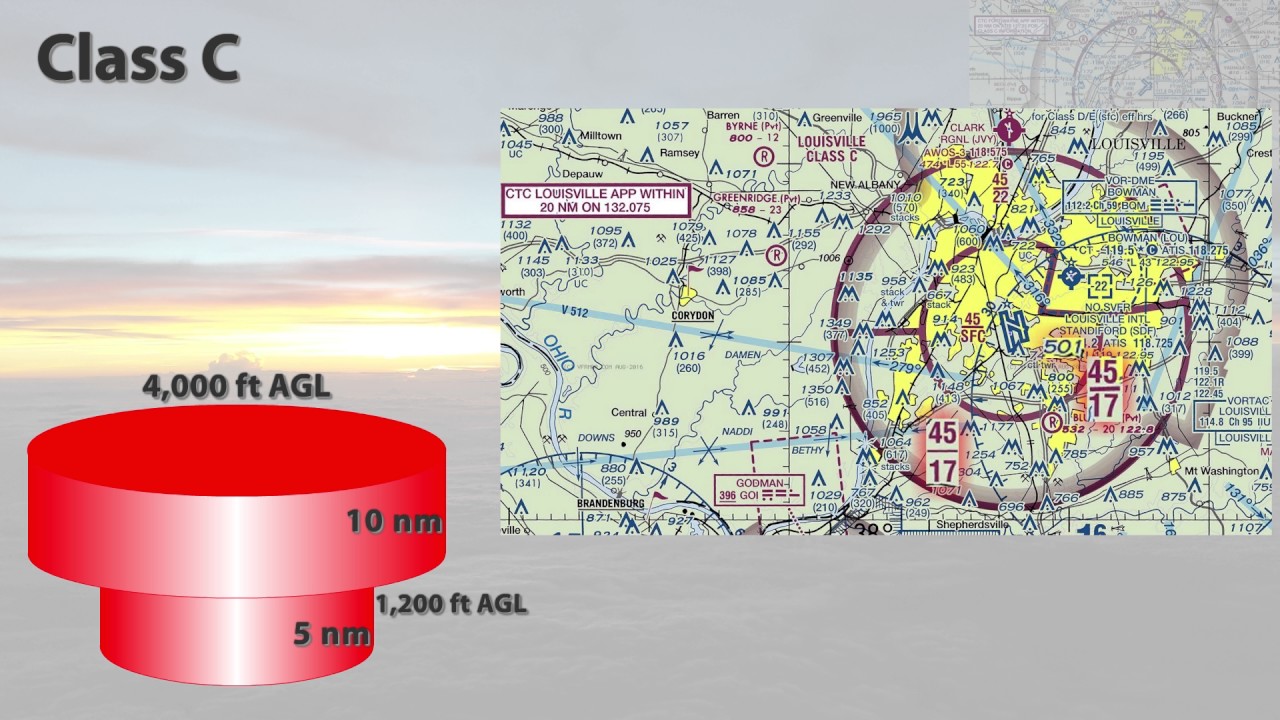
You need to have two-way communication mode C and an ATC clearance. The outer shelf for the C airspace extends from 5 to a 10 nautical mile radius with standard vertical limits from 1500 to 4000 feet AGL. Class C airspace is generally airspace from the surface to 4000 feet above the airport elevation charted in MSL surrounding those airports that have an operational control tower are serviced by a radar approach control and have a certain number of instrument flight rules IFR operations or passenger enplanements.
Flights above 5000 ft MSL or 3500 ft AGL whichever is higher Transponder Code for VFR flights. Flight Rules Pilot Equipment Requirements. Generally from surface up to 4000 feet MSL including the airspace above the horizontal boundary up to 10000 feet MSL.
While you dont need an operable transponder to fly below a Class C shelf you will need one to fly above Class C airspace. Both IFR and Visual Flight Rules VFR flying is permitted in this airspace but pilots require clearance to enter and must comply with ATC instructions. Over the Gulf of Mexico at and above 3000 feet MSL within 12 nautical miles of the coastline of the United States.
San Jose and Oakland airports are surrounded by class C airspace C for Crowded. To enter Class C airspace all aircraft must meet the following requirements. 15 Zeilen Class B.
Class C Weather Requirements Class C requires 3SM visibility 1000 above clouds 500 below clouds and 2000 horizontal. Requirements of Class C Airspace. No Specific Pilot Certification is required but you will need to an additional endorsement if operating in Class C airspace with a sport pilot certificate.
Call ATC on the radio before youre in Class C. VFR flights in class C airspace must have three miles 5 km of visibility and fly an altitude at least 500 feet 150 m below 1000 feet 300 m above and 2000 feet 600 m laterally from clouds. A Mode C transponder with ADS-B out is required to fly in but also above Class C airspace.
Class D is used for controlled zones or above and around airspace Class C designated zones where CVFR is not necessary. To enter Class C airspace the pilot must establish two-way radio contact but specific clearance isnt required. Depicted as sfc40 or 1540.
Above 10000 feet MSL over the 48 states and DC excluding airspace at and below 2500 feet AGL. Communications Airspace Features Class A Airspace Class B Airspace Class C Airspace Class D Airspace Class E Airspace Class G Airspace. Not only are the dimension of Class C airspace easy to understand it is also easy to enter.
Outer ring is 10nm. Flights in airspace C oder D non-control zone flights in transponder mandatory zones TMZ flights at night in controlled airspace. Before we enter Class C we should review the frequencies airspace dimensions.
Entering class C airspace begins in the same manner as every flight by becoming familiar with all available information. As you approach a Class C airport youll contact that airspaces approach control. There is no specific pilot certification required.
Two-way radio communication usually by first calling approach control Establish communication with approach control or in rarer circumstances call tower directly. Operating within class C Airspace. Class E is used for airspace between usually 2500 ft 760 m AGL around airports 1000 ft 300 m or 1700 ft 520 m AGL and FL 100.
A bravo clearance is good for just one entry into the bravo. What are the airplane requirements to operate in Class C airspace. Although the configuration of each Class C area is.
The inner core for class C airspace has a 5 nautical mile radius with standard vertical limits from the surface to 4000 feet AGL. Altitudes are giver in hundreds of feet. Airspace Requirements for Weather Minimums.
VFR flights are separated from IFR flights and receive traffic information in respect of other. Each person operating an aircraft in Class C airspace must meet the following two-way radio communications requirements. What services are provided for aircraft operating within Class C airspace.
Cleared into the class Bravo does the trick. Inner ring is 5nm radius from the surface to 1200 agl. IFR and VFR flights are permitted all flights are provided with air traffic control service and are separated from each other.

Air Traffic Control Class B G Class

Instrument Flying Handbook Chapter 8 American Flyers Aviation Training Aviation Airplane Aviation Education

Airspace Classes In 2021 International Civil Aviation Organization Class Class B

The Logic Behind Class E Airspace Boldmethod Aviation Training Flight Training Ground School

Altitude Height Google Suche

Class C Atc Communication Vintage World Maps Learn To Fly Class

Ils Instrument Landing Systems Instrument Landing System Aviation Airplane Aviation Training

The Logic Behind Class E Airspace Boldmethod Student Pilot Aviation Training Flight Training

What Is The Minimum Flight Visibility And Proximity To Cloud Requirements For Vfr Flight At 6 500 Feet Ms Pilots Aviation Aviation Training Aviation Education
Class C Airspace Defined Youtube Class Echo Dot Music Record

Airspace Classifications Chapter 1 Instrument Flying Handbook Aviation Training Aviation Education Flight Instruction

Airspace At A Glance Card Know At A Glance What The Weather Minimums And Communication Requirements Are For Aviation Training Student Pilot Aviation Airplane
How To Memorize Airspace In 5 Minutes Youtube How To Memorize Things Simple Tricks Understanding

Segmented Circle And Airport Traffic Patterns Pilot S Handbook Of Aeronautical Knowledge Chapter 12 Am Aviation Education Aviation Training Pilots Aviation

Quiz How Much Do You Know About Class G Airspace Flight Instruction Pilot Training Aviation Charts

How To Remember Vfr Weather Minimums Bobbie Lind How To Memorize Things Remember Weather

Pin On Orienteering

Vfr Minimums Aviation Education Aviation Training Helicopter Pilot Training

Quiz Do You Know Your Airspace Student Pilot News Student Pilot Flight Lessons Quiz

Post a Comment for "Class C Airspace Requirements"